Solar Cost per Watt: What's a Fair Price in 2026?
- The average solar cost per watt in 2026 ranges from $2.50 to $3.50, before incentives, with most homeowners seeing $2.80 to $3.00 per watt.
- System cost per watt is influenced by location, system size (larger systems are cheaper per watt), equipment tier, roof complexity, and the installer's business model.
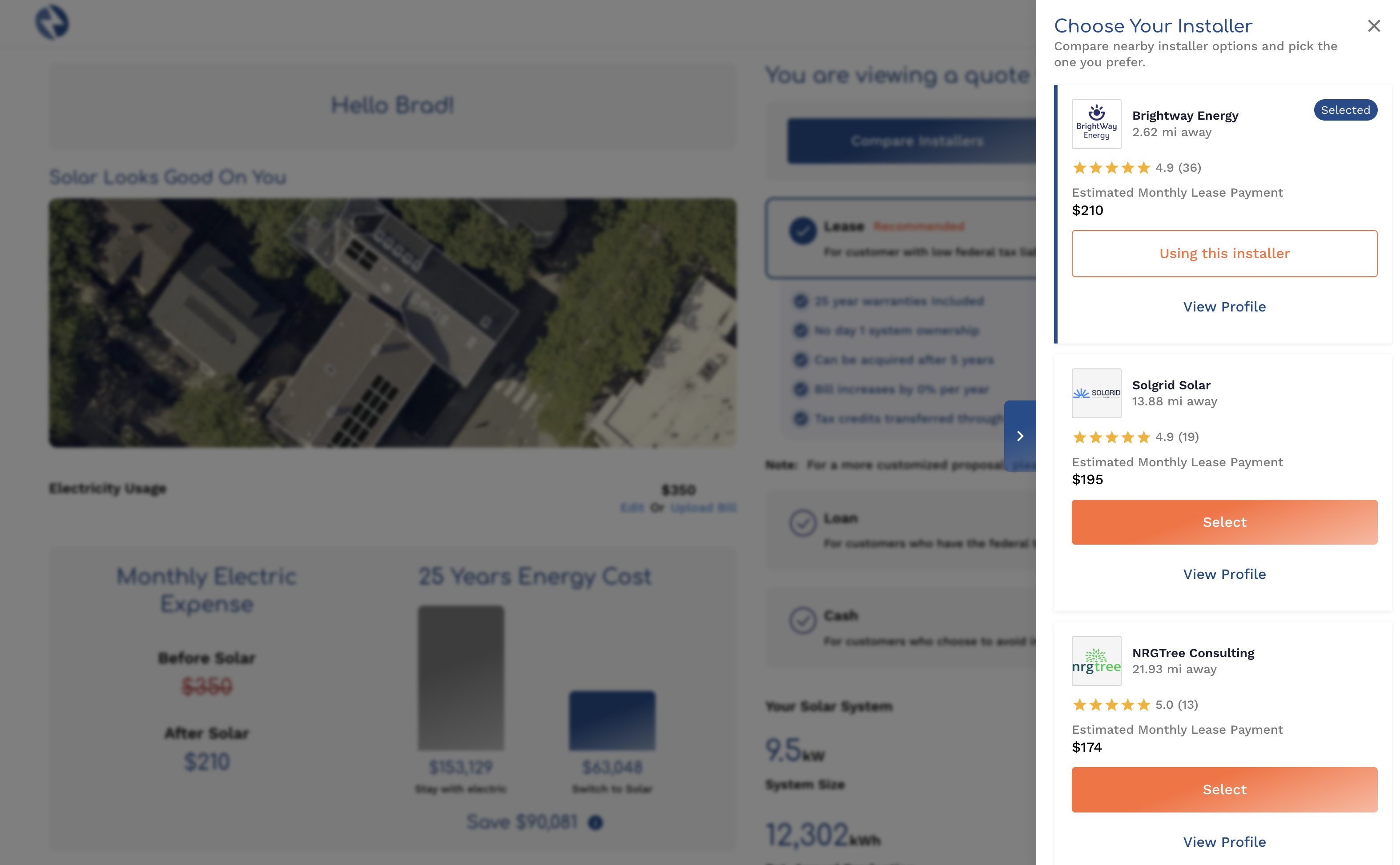
- With Terawatt you get multiple installer proposals against one standard design for your home. This enables apples to apples comparison instead of trying to decode completely different proposals.
The average solar quote lands somewhere between $18,000 and $35,000. Most homeowners have no idea whether that number is fair, inflated, or a steal.
Cost per watt is the one metric that cuts through the noise and lets you compare quotes side by side. By the end of this, you'll know what a fair solar cost per watt looks like in 2026, what drives the range, and how to spot a quote that is trying to take advantage of you.
What "Cost Per Watt" Actually Means
It's the total installed system price divided by the system's capacity in watts.
A 10 kilowatt system quoted at $30,000 works out to $3.00 per watt. A 12 kilowatt system at $36,000 is the same price per watt. Without this number, comparing two quotes side by side is almost impossible.
This figure covers everything: panels, inverters, mounting hardware, electrical work, permits, and labor. It does not factor in tax credits or incentives. Always compare cost per watt before incentives, so you're looking at the same baseline across every quote.
The 2026 National Average
The average solar cost per watt in 2026 is approximately $2.50 to $3.50 installed, with most homeowners landing around $2.80 to $3.00 per watt before any incentives.
For a typical 10 kW residential system, here's what that looks like in real dollars:
| A | B | C | D |
|---|---|---|---|
| System Size (kW) | Low | Average | High |
| 8 | $20,000 | $24,000 | $28,000 |
| 10 | $25,000 | $30,000 | $35,000 |
| 12 | $30,000 | $36,000 | $42,000 |
Prices have stabilized over the past two years after sharp declines through 2023. Hardware costs (panels, inverters) continue to fall. Soft costs like labor, permitting, and sales overhead have not. That gap is what keeps the installed cost per watt from dropping further.
Why Your Quote Might Be Higher or Lower
Five factors move the needle most.
Location. Labor rates, permitting complexity, and market competition vary significantly by state. Massachusetts and New York homeowners typically see quotes of $3.00 to $3.40 per watt. Texas and Arizona can run as low as $2.10 to $2.85 per watt. Where you live accounts for more of the price difference than most people realize.
System size. Larger systems cost less per watt. Fixed soft costs like design, permitting, and the site visit are spread across more kilowatts. A 6 kW system from the same installer will almost always cost more per watt than a 12 kW system.
Equipment tier. Premium panels (REC Alpha, Panasonic Evervolt, SunPower Maxeon) run $0.20 to $0.50 more per watt than mainstream Tier 1 brands (Q CELLS, Canadian Solar, Jinko). The efficiency gap matters most on small or shaded roofs. For a clear, south‑facing roof with plenty of space, mid‑tier panels often make more financial sense.
Your roof. Steep pitches, multiple facets, and complex layouts add labor time. A simple gable roof with unobstructed south exposure gets the most competitive bids.
The installer's business model. National installers carry high overhead: call centers, door‑to‑door canvassing, heavy marketing budgets. Local installers with lower customer acquisition costs often pass those savings directly to price. Local installers beat national companies on price about 70% of the time.
What's Actually a Fair Price in 2026?
Here's a straightforward benchmark:
Price Per Watt What It Suggests
Under $2.00/W
Undersized system, low‑quality equipment, or a bait quote
$2.00-$2.50/W
Competitive in low‑cost markets (Southwest, Texas). Verify specs carefully.
$2.50-$3.00/W
Fair for most US markets. This is the value sweet spot.
$3.00-$3.50/W
Standard in the Northeast and higher‑labor markets. Acceptable with solid equipment.
Over $3.50/W
Requires scrutiny. Premium equipment or complex install can justify it. Ask why.
If your quote is above $3.50 per watt and the installer cannot explain the reason clearly, that is a problem.
Red Flags to Watch For
No equipment specifics listed. Any quote that says "premium panels" without naming the manufacturer, model, and wattage is hiding something. You should know the exact make and model of every major component before you sign.
A sudden price drop you didn't ask for. If an installer cuts $5,000 to $10,000 without negotiation, they started that much too high. A reputable quote doesn't have $10,000 of room built in from the start.
Pressure to sign fast. A legitimate solar quote should be valid for at least 30 days. "This price expires tonight" is a sales tactic, not a real deadline.
Financing that inflates the system price. Some installers quietly increase the quoted system cost to cover dealer fees or financing costs. Your cash price and financed price should reflect the same underlying system. If they don't, ask for the itemized breakdown.
The Bottom Line
In 2026, a fair solar price per watt is $2.50 to $3.50 installed, before incentives. The national midpoint is around $2.80 to $3.00 per watt.
Most homeowners get one or two quotes and sign. That's the wrong move. The only way to know if a price is fair is to compare it against others, on the same design.
That's exactly what Terawatt does. You get one standardized solar design for your home, and multiple installers quote against it. Same system size, same equipment specs, same production estimate. You see each installer's price per watt side by side, along with the specific equipment each one is proposing, so you're comparing apples to apples instead of trying to decode three completely different proposals.
No sales calls. No pressure. Just your numbers.
Sources used in this post: EnergySage, Solar.com, SolarReviews, NuWatt Energy, Boston Solar, EcoFlow, ConsumerAffairs, Palmetto, Paradise Energy, NEDES Solar.